Canton: Appenzell Innerrhoden
Accessibility adaptations in the canton of Appenzell Innerrhoden
Accessibility adaptations in the canton of Appenzell Innerrhoden: describe the work, the exact location and the conditions on site. Add your preferred dates and useful photographs to prepare your quote request.
Local quote request
Describe your project now
Share the work needed, the postcode and any photos you have. A clear request helps our team forward it to the relevant companies.
- No client account required
- Request reviewed before forwarding
- Contact details shared only with eligible companies
Your contact details are not published. A summary of the work may be forwarded to the relevant companies.
Quotes and timescales are agreed directly with the companies.
Work and requirements
- Practical obstacles at entrances, thresholds and circulation routes
- Room and doorway dimensions, turning space and equipment used
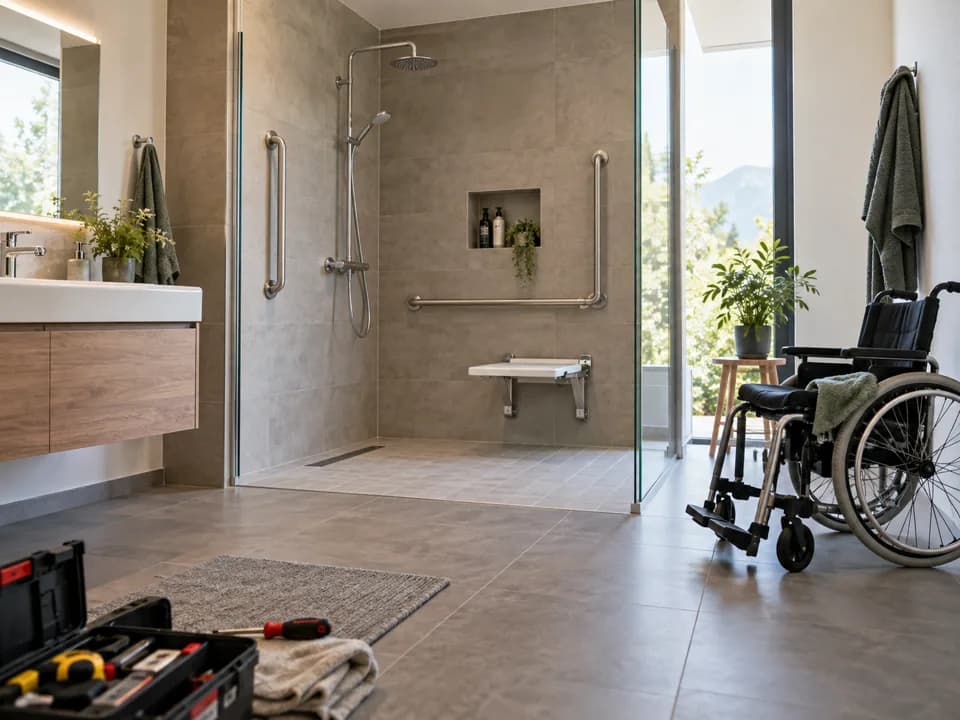
- Bathroom, control or access adaptations needed without medical diagnoses
- Retained features, occupant needs and assessment of the proposed solution
Your project in the canton of Appenzell Innerrhoden
At the foot of the Alpstein, Appenzell Innerrhoden is a landscape of green hills, scattered farmhouses and villages with strong character. The village of Appenzell is famous for its timber houses with brightly painted façades, while Gonten, Schwende and Weissbad have more dispersed settlements, often on sloping ground. The Oberegg enclave, closer to the Rhine Valley, combines traditional houses with more recent buildings. Many properties are old, with timber structures that call for specialist skills when it comes to insulation, windows or woodwork. The canton is German-speaking, yet your request can be written in English. For any project affecting the outside of a traditional Appenzell house, check with your municipality. State the village, postcode and width of the access road if the house is on a slope or outside the village.
- For a timber house with painted façades, attach photos of the exterior so that tradespeople can assess the work.
- If your farmhouse is isolated, describe the access road and how passable it is in winter.
- Give the approximate age of the building, as insulation methods differ for old timber houses.
Accessibility adaptations for people with reduced mobility in the canton of Appenzell Innerrhoden
In Appenzell Innerrhoden, traditional farmhouses, with their timber façades and low rooms, are poorly suited to wheelchairs: raised thresholds, narrow doors and steep stairs are the rule. Adapting such a house requires tact, so as to preserve the character of the woodwork while widening a passage or creating a ground-floor bedroom. In the colourful houses of Appenzell village, the entrance often opens straight onto the street and leaves little room for a ramp. On isolated farms around Gonten, the access path, snow and slope of the land matter as much as the interior. For any change visible from outside, consult the municipality first.
- In an old timber house, ask whether the walls can take grab rails or whether reinforcement is needed behind the panelling.
- For a farm on a slope, have a covered path to the door designed so that snow does not block a wheelchair in winter.
Request a quote in the canton of Appenzell Innerrhoden
Request a quote in the canton of Appenzell InnerrhodenQuotes and timescales are agreed directly with the companies.
Who handles your request
- Your request is read by the e-quote.ch team in Geneva before it is forwarded.
- The request is handled according to the trade and work location you specify.
- You compare the replies freely, with no obligation; the quote and contract are agreed directly with the company.
e-devis.ch is operated from Geneva. The platform forwards requests and does not carry out the work. How it works · Contact
Main municipalities
All localities in the canton of Appenzell Innerrhoden
Other trades in the canton of Appenzell Innerrhoden
Frequently asked questions
How should an accessible route be defined in Appenzell Innerrhoden?
Identify the starting point, rooms and everyday tasks the route must connect, including entrances and shared areas. Note thresholds, door movement and equipment used without publishing medical diagnoses. Ask for assessment of the whole route, so adapting one doorway does not leave another practical obstacle unresolved.
How can I describe accessibility needs without medical details?
Explain the movements and tasks that are difficult, the equipment used and the relevant room or doorway dimensions. A description of the practical obstacle can support planning without a medical history. Ask for an assessment of the actual space and the proposed solution before selecting equipment.
What should I compare in adaptations for reduced mobility quotes?
Compare adaptations against the same practical needs, including door clearances, manoeuvring space and controls. Clarify installation, testing and making good surrounding finishes. Ask which assessments are necessary and who coordinates them; a product alone does not establish that the complete route is accessible.
How should I prepare for the adaptations for reduced mobility visit or work?
Prepare a simple route plan from the entrance to the rooms used most. Note thresholds, narrow points and items to retain. Discuss the proposed changes with the person who will use them, and arrange any specialist assessment privately when it is relevant.